
Introduction: The Renaissance of Smart Eyewear
The landscape of wearable technology is currently undergoing a seismic shift, moving rapidly from the realm of novelty gadgets to indispensable daily tools. For over a decade, the concept of smart glasses has hovered on the periphery of consumer electronics, often plagued by bulky designs, poor battery life, and a lack of clear utility. However, recent developments in Smart Glasses News indicate that the industry is pivoting toward a more mature, bifurcated strategy. Major tech giants are no longer betting on a single form factor to solve every problem. Instead, we are witnessing the emergence of two distinct categories: high-fidelity visual augmented reality (AR) displays and lightweight, audio-first AI companions.
This strategic split is driven largely by the explosion of generative AI. In the past, smart glasses needed onboard processing power to overlay simple notifications. Today, they serve as edge points for massive Large Language Models (LLMs) capable of multimodal understanding. Whether it is a pair of glasses equipped with MicroLED screens projected for a 2026 timeline or sleek, screen-less frames focused on audio and camera input available sooner, the goal remains the same: to reduce friction between the user and the digital world. This article explores the technical nuances, market implications, and future trajectory of this dual-approach ecosystem, touching upon everything from AI Assistants News to the broader implications for Wearables News.
The Great Divide: Screen-Based AR vs. Audio-First AI
To understand the future of smart eyewear, one must analyze the two diverging paths engineers are taking. This is not merely a difference in features; it is a fundamental difference in philosophy regarding how humans should interact with AI.
The Visual Path: Full Augmented Reality
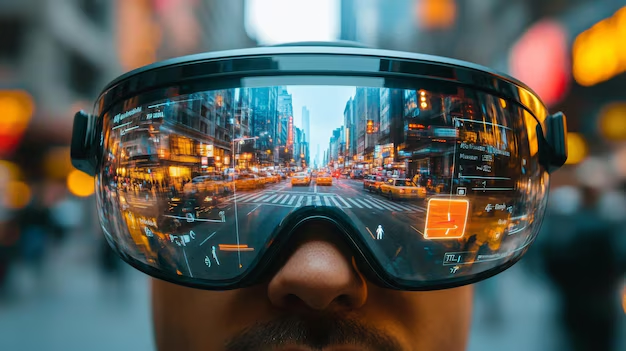
The “Holy Grail” of smart glasses has always been the Heads-Up Display (HUD). The vision involves overlaying digital information seamlessly onto the physical world. According to recent AR/VR AI Gadgets News, the next generation of screen-based glasses aims to integrate advanced MicroLED or waveguide technology. These devices are designed to be true computing replacements.
Technically, these devices face the “physics problem.” To project high-resolution images that are visible in daylight requires significant power, which generates heat. Placing hot batteries and processors next to the human temple is a complex thermal engineering challenge. However, the utility is undeniable. Imagine looking at a foreign language menu and seeing the translation overlay directly on the paper, or following navigation arrows painted virtually on the sidewalk. This category intersects heavily with AI Education Gadgets News, where students could receive visual prompts during complex tasks, and AI for Accessibility Devices News, providing real-time captions for the hearing impaired directly in their field of view.
The Audio-First Approach: The AI Whisperer
Conversely, the second category abandons the screen entirely. By removing the display, manufacturers can reduce weight, improve battery life, and maintain a form factor that looks like traditional eyewear. These devices rely on cameras for input and open-ear speakers for output. This sector is currently dominating AI Audio / Speakers News.
The primary interaction model here is conversational. The user asks a question, and the AI—seeing what the user sees through the camera—responds via audio. This “multimodal” capability transforms the glasses into an always-on consultant. For instance, a user could look at a leaking pipe and ask, “How do I fix this?” The AI analyzes the visual data and dictates instructions. This approach is rapidly accelerating AI Phone & Mobile Devices News, as these glasses effectively act as a headless terminal for the smartphone in your pocket.
Deep Dive: The AI Engine and Multimodal Context

Artificial intelligence analyzing image – Convergence of artificial intelligence with social media: A …
Regardless of whether the glasses have screens or just speakers, the true revolution lies in the software. The integration of Gemini-class or GPT-4-class models into wearable form factors is the catalyst for the current Smart Glasses News cycle.
Multimodality: Seeing and Hearing
Early voice assistants were unimodal; they processed text-to-speech. Modern smart glasses utilize multimodal AI, which processes video, audio, and location data simultaneously. This allows for “contextual awareness.” In the context of AI Kitchen Gadgets News, a user could look at a pile of ingredients on a counter, and the glasses could suggest recipes based on exactly what is visible, factoring in dietary restrictions known by the user’s profile.
Furthermore, this technology extends to AI Sensors & IoT News. The glasses act as a mobile sensor suite. If connected to a broader smart home ecosystem, looking at a smart thermostat and saying “make it warmer” eliminates the need to specify which device you are talking to; the glasses know what you are looking at. This seamless interaction is a major leap forward for Smart Home AI News.
Edge Computing vs. Cloud Processing
A critical technical debate in AI Edge Devices News is how much processing happens on the face versus in the cloud. For immediate tasks like object recognition or translation, latency is the enemy. Future iterations of smart glasses, particularly those launching around the 2026 window, are expected to feature dedicated Neural Processing Units (NPUs) to handle lighter AI tasks locally. This ensures privacy and speed, only offloading complex queries to the cloud when necessary. This balance is vital for AI Security Gadgets News, as users are increasingly wary of constant video streams being sent to remote servers.
Real-World Applications and Industry Verticals
The bifurcation of smart glasses opens up specific use cases across various industries. The utility of these devices extends far beyond checking notifications.
Healthcare and Wellness
In the realm of Health & BioAI Gadgets News, smart glasses are poised to become health monitors. Audio-focused glasses can already track posture and head movement. Future iterations with sensors could monitor blood flow or pupil dilation to detect fatigue. For surgeons, screen-based AR glasses can overlay vitals or MRI scans directly onto the patient during surgery, a revolutionary step in medical tech.
Furthermore, AI Sleep / Wellness Gadgets News suggests that wearing blue-light-regulating smart glasses could actively help manage circadian rhythms, adjusting the tint of the lenses (electrochromic) based on the time of day and the user’s biological data.
Field Work and Enterprise
For AI Office Devices News and industrial applications, the screen-based variant is superior. Field technicians repairing wind turbines or complex machinery benefit from hands-free schematics. This also ties into Robotics News and Drones & AI News. A drone pilot could control a UAV while seeing the drone’s camera feed in a picture-in-picture mode on their glasses, allowing for safer line-of-sight operation.

Artificial intelligence analyzing image – Artificial Intelligence Tags – SubmitShop
Creative and Social
AI Tools for Creators News is buzzing with the potential of smart glasses. First-person perspective (POV) video capture is becoming a standard for social media. AI editing tools can now automatically highlight interesting moments from a day’s recording. Additionally, AI in Fashion / Wearable Tech News highlights that style is no longer secondary. The partnership between tech giants and luxury eyewear brands proves that for glasses to be worn, they must first be fashionable.
Implications for the Broader AI Ecosystem
Smart glasses do not exist in a vacuum; they are the connective tissue between various AI domains.
The Controller for Everything
As Neural Interfaces News develops, we may see glasses paired with wristbands that detect electromyography (EMG) signals, allowing users to “click” on virtual interfaces without raising their hands. But even without neural tech, glasses are becoming the universal controller.
Imagine looking at your Robotics Vacuum News-worthy cleaner and telling it to “clean that specific spot,” with the glasses designating the coordinates. Or, in the context of AI Pet Tech News, using the camera to identify if a plant in the garden is toxic to your specific breed of dog. The glasses bridge the gap between intent and action.
Mobility and Infrastructure
In Smart City / Infrastructure AI Gadgets News, smart glasses serve as a pedestrian interface. They can communicate with Autonomous Vehicles News systems to alert wearers of oncoming traffic that isn’t yet visible around a corner. For AI for Travel Gadgets News, the implications are massive: real-time currency conversion, landmark history narration, and navigation that keeps your head up rather than buried in a phone.
Artificial intelligence analyzing image – Artificial intelligence in healthcare: A bibliometric analysis …
Pros, Cons, and Critical Considerations
While the future looks bright, there are significant hurdles to overcome before mass adoption occurs.
Pros:
- Reduced Screen Time: Ironically, adding screens to eyes might reduce phone addiction. Audio-first glasses allow users to remain present in the real world while staying connected, a positive trend in AI Monitoring Devices News.
- Enhanced Accessibility: For the visually impaired, AI narrators describing the world are life-changing.
- Hands-Free Productivity: Essential for manual labor, cooking, or AI in Sports Gadgets News where athletes need data without breaking stride.
Cons and Challenges:
- Privacy Concerns: The “glasshole” stigma remains. AI-enabled Cameras & Vision News frequently discusses the ethical implications of recording in public spaces. Manufacturers must implement robust LED indicators and privacy protocols.
- Battery Life: This is the bottleneck for AI Research / Prototypes News. Powering cameras, AI processing, and potentially screens requires energy density that current lithium-ion tech struggles to provide in a lightweight frame.
- Social Acceptance: AI in Gaming Gadgets News shows that while gamers accept bulky headsets, the general public is resistant to wearing obvious tech on their faces. The form factor must be indistinguishable from standard eyewear.
Conclusion: A Vision of the Future
The upcoming years will define the trajectory of personal computing. The strategy to split smart glasses into two categories—screen-based for immersion and audio-based for assistance—is a pragmatic recognition of current technological limits and consumer behaviors. We are moving toward a world where AI Personal Robots News isn’t just about droids in our homes, but the robotic intelligence we wear on our faces.
From AI Gardening / Farming Gadgets News helping us identify plant diseases at a glance, to AI Lighting Gadgets News allowing us to control our environment with a look and a command, smart glasses are the key to unlocking the ambient computing future. Whether you choose the immersive visual experience of 2026 or the subtle audio companion of today, the way we view the world is about to change permanently.