


I got a letter in the mail last Tuesday. No return address I recognized, just a generic “Processing Center” stamp that usually means one thing: I owe someone money.
Inside was a grainy photo of my rear bumper and a demand for $450. The crime? Apparently, I failed to stop for a school bus stop arm three weeks ago. The evidence? A video link and a timestamp.
Here’s the kicker: I remember that drive. I remember the bus. And I remember stopping. But the AI mounted on the side of that yellow Blue Bird disagreed with me. After fighting it for three hours on a buggy municipal website, I realized something. We aren’t just installing safety equipment anymore. We’re deploying autonomous revenue collectors.
The tech behind these new stop-arm cameras is impressive, terrifying, and frankly, a little broken. Let’s talk about what’s actually bolted onto these buses, because it’s not just a GoPro anymore.
It’s Not a Camera, It’s an Edge Server
If you haven’t looked closely at a school bus lately—and honestly, why would you unless you’re a parent or a mechanic—you might have missed the hardware creep. Back in 2023, you’d see maybe one or two external cameras. Now? Some of these fleets are running five to eight sensors on the exterior alone.
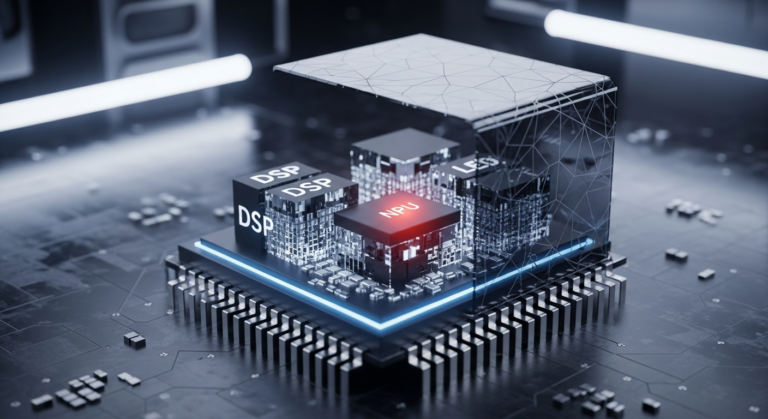
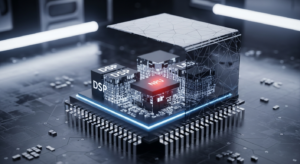
We’re talking high-definition, high-framerate sensors paired with local compute units. They aren’t streaming video to the cloud for analysis—that would kill the cellular data budget in a week. Instead, they’re running edge inference right there on the bus. The AI models are trained to detect the specific geometry of a vehicle passing the extended stop arm while the red lights are flashing.
Technically, it’s cool. They use object detection to lock onto license plates across multiple lanes, even in low light. I’ve dug into the specs of a few leading vendors, and they’re boasting about 98% capture rates and “predictive violation tracking”—basically guessing if you’re going to blow the stop sign before you actually do based on your speed.
But “predictive” is a slippery slope.
The False Positive Nightmare
So, back to my ticket. I watched the video evidence. I stopped. I definitely stopped. But I stopped past the sensor’s trigger line because a delivery truck was tailgating me and I didn’t want to get rear-ended. I rolled forward a few feet to clear the intersection, then halted.
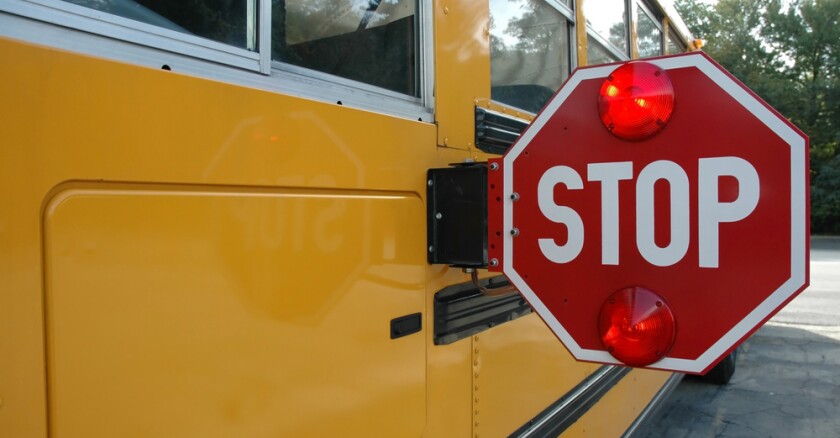
To a human police officer, that’s defensive driving. To the AI model, that’s a “rolling violation.”
This is the problem with binary code enforcing nuanced traffic laws. The AI sees motion + stop arm = ticket. It doesn’t understand context. It doesn’t see the guy behind you on his phone about to smash into your trunk. It just executes the logic loop.
I’m seeing reports from all over the country about this. Shadows being read as lane infractions. glare from wet pavement confusing the OCR (Optical Character Recognition) on license plates, sending tickets to the wrong people. One guy in Ohio got fined because the bus driver deployed the stop arm while the car was already passing. The camera didn’t care about the timing; it just saw the car and the arm in the same frame.
Safety or Surveillance?
Look, I have kids. I don’t want maniacs speeding past school buses. It’s dangerous, and people who do it recklessly deserve the fine. But there’s a weird shift happening in how this tech is pitched versus how it’s used.
The pitch is always “Safety First.” The reality feels a lot more like “Budget Deficit Solved.”
Many of these camera systems are installed at zero upfront cost to the school districts. The vendors—private tech companies—install the hardware for free in exchange for a cut of the ticket revenue. Sometimes a huge cut. We’re talking 40% to 60% of every fine going directly to the tech provider.
Think about the incentives there. If the AI model has a sensitivity dial, and you’re the vendor, where are you setting it? Are you tuning it to be lenient and only catch the egregious violators? Or are you tuning it to flag anything that even remotely looks like a violation so you can maximize volume?
It creates a predatory loop. The camera companies need violations to recoup their hardware investment. The cities get addicted to the easy revenue stream. And the drivers get stuck with $500 fines for rolling three inches past a line.
The Tech Stack is Getting Aggressive
What really worries me isn’t the current state, but where the roadmap goes next. I’ve been reading up on the next-gen sensors hitting the market in early 2026.
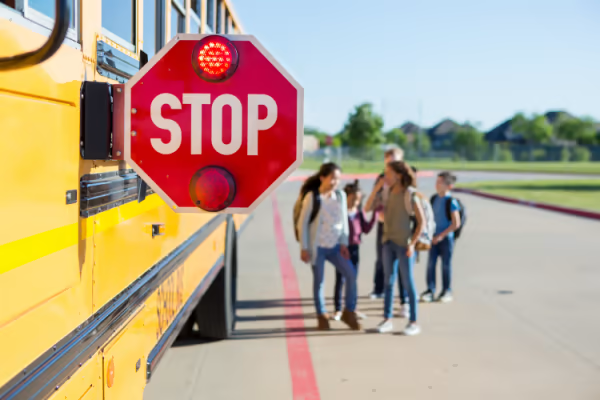
We’re moving beyond simple stop-arm enforcement. Some vendors are piloting “driver distraction detection” from the bus. High-res cameras aimed into passing cars to see if you’re holding a phone. If they can snap your plate, they can snap your profile.
There’s also talk of “neighborhood analytics.” Since these buses drive the same routes every day, they’re perfect data vacuums. They can map Wi-Fi networks, track parked cars, and monitor foot traffic patterns. Who owns that data? The school district? The private vendor? The city police?
Usually, the contract says the vendor owns the “anonymized” data. But we all know how easy it is to de-anonymize location data.
What Actually Works?
If we really wanted to stop people from hitting kids, we wouldn’t just be mailing them tickets two weeks later. That doesn’t stop the accident today. It just punishes you later.
I’d rather see that tech budget go toward active safety. Why aren’t we using V2X (Vehicle-to-Everything) communication? By late 2026, a decent chunk of cars on the road will have some level of V2X capability. The bus should be screaming electronically at my dashboard to force a brake event if I’m coming in too hot.
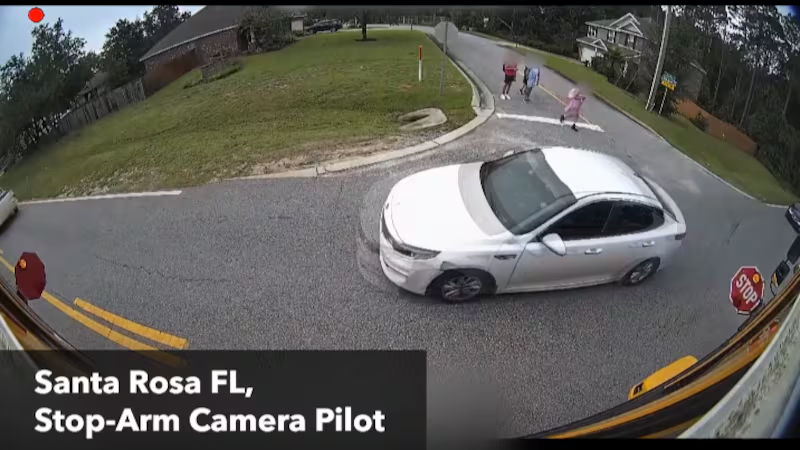
That prevents the crash. A camera just monetizes it.
But V2X is hard. It requires standards, cooperation between automakers, and infrastructure. Slapping a camera on the side of a bus and splitting the profits? That’s easy. That’s a business model.
Fighting Back
If you get one of these automated tickets, don’t just pay it. Review the footage. Check the timestamp. Look for:
- Stop Arm Timing: Did the arm fully extend before you passed? In many states, the law requires the arm to be fully extended and lights flashing.
- Lane Position: On four-lane roads, laws vary wildly about whether oncoming traffic has to stop. The AI often gets this wrong.
- Context: Was there a safety reason you couldn’t stop instantly?
I contested mine. I pointed out the truck behind me in the video frame. I argued that sudden braking would have caused an accident. To my surprise, a human actually reviewed it and dropped the fine.
But how many people just pay the $450 because they’re scared or too busy to fight? That’s what these systems bank on. Friction.
We need AI in transportation. It can save lives. But right now, on school buses, it feels less like a guardian angel and more like a robotic toll booth. And until we fix the incentives, it’s only going to get more expensive to drive to work.