
Matter 1.0 launched in late 2022 with a lot of marketing energy and a small problem: it didn’t actually do most of what people wanted from a smart home standard. The device categories were limited (lights, plugs, locks, thermostats, sensors — and not much else), the multi-admin pairing flow was broken in subtle ways, and the Thread network setup required more knowledge of mesh radio topology than any consumer should have to learn. Matter 1.4, released in late 2024 and now shipping in mainstream products, fixed most of those issues. This article walks through what changed, what’s still broken, and why this version is the one to actually try if you’ve been holding off.
Why Matter exists in the first place
The smart home market spent its first decade locked in vendor silos. Every device manufacturer ran their own cloud, every cloud spoke its own protocol, and the only way to make a Phillips Hue light show up in a Google Home app was for Phillips and Google to sign a custom partnership agreement and write a custom integration. Multiply that by every brand and every voice assistant and you get the thousand-pairwise-integrations problem the industry has been complaining about since 2015.
Matter was supposed to fix this by being one protocol that every device manufacturer agrees to speak. A Matter-certified light bulb, in theory, should pair with any Matter-certified hub from any vendor — Apple HomeKit, Google Home, Amazon Alexa, Samsung SmartThings, all of them — without any integration work. The bulb broadcasts that it’s a Matter device, the hub recognizes it, the user scans a QR code, and the device shows up.
What Matter 1.0 through 1.3 actually delivered
The first three Matter releases got the basics right. Lights worked. Switches worked. Plugs worked. Sensors worked. The pairing flow was usually one QR code scan and a 30-second wait while the hub commissioned the device onto the local network. For those four device categories, Matter genuinely delivered the promise.
The categories that didn’t work or were missing entirely:
- Cameras. Not in spec at all until Matter 1.2, and even then the support was limited to status messages and snapshots — no actual video streaming.
- Robot vacuums. Added in 1.2 but with a feature set that excluded mapping, no-go zones, and most of what you actually buy a robot vacuum for.
- Energy management devices. Smart meters, EV chargers, solar inverters — no spec at all until 1.3 added EV chargers tentatively.
- Multi-admin properly working. The flow that lets the same device be controlled by both an Apple Home network and a Google Home network simultaneously was technically supported but had bugs in every implementation through 1.3. If you paired a device to one hub and then added it to a second, you typically lost the first pairing or got into a state where neither hub trusted the device.
The result was that early Matter adopters used it for the four working categories, fell back to vendor-specific apps for everything else, and got the worst of both worlds — a confusing mix of Matter and non-Matter devices in the same room.
What Matter 1.4 added
Matter 1.4 is the release that closed most of the gaps. The headline additions:
- Energy management cluster. Solar inverters, battery storage systems, and smart electrical panels are now first-class citizens. Read current production, current consumption, set charge schedules — all through standard Matter clusters.
- Long-form HVAC. Heat pumps and multi-zone systems beyond simple thermostats. Vendors like Mitsubishi and Daikin shipped Matter-compatible firmware throughout 2025.
- Kitchen appliances. Refrigerators, ovens, washers, dryers. Limited to status reporting and a few control commands, but it’s the first time the spec acknowledged those devices exist.
- Multi-admin reliability fixes. The pairing flow that lets a device be controlled by multiple ecosystems now works in practice. Pair to Apple Home, then add to Google Home, both work simultaneously, neither breaks the other.
- Thread network credentials sharing. If you have a Thread Border Router (a HomePod mini, an Apple TV 4K, an Echo Hub, a Nest Hub Max), your iPhone can now share the Thread network credentials with any other compatible device on your home network so all your Matter-over-Thread devices end up on a single mesh.
The Thread network problem and why 1.4 mostly fixed it
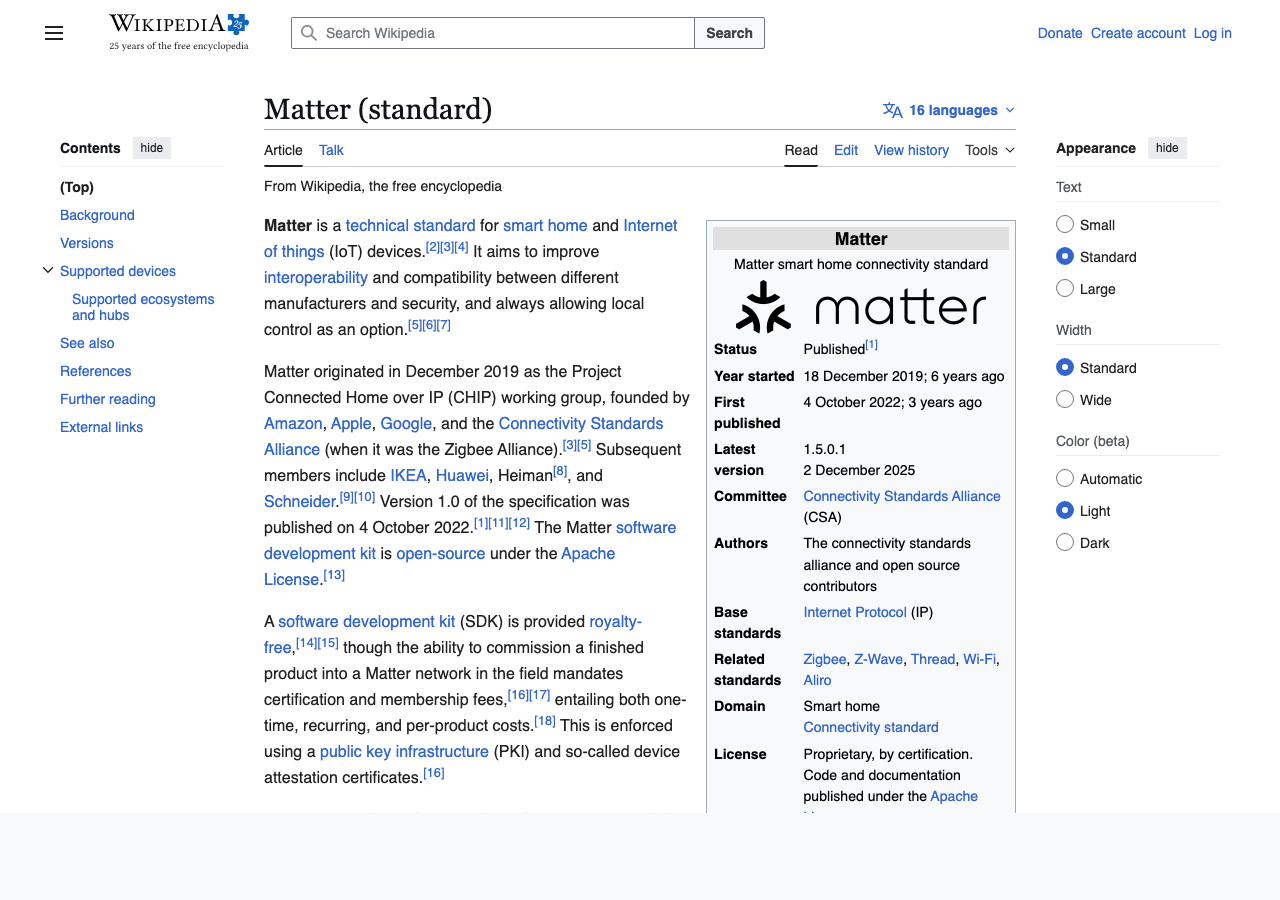
One of the genuinely hard things about Matter has been Thread. Thread is a low-power mesh radio protocol — a bit like Zigbee but built around IPv6 — and Matter devices that are battery-powered or low-throughput typically run on Thread instead of Wi-Fi. The catch: a Thread network needs a Border Router to bridge the mesh to the rest of your home network, and prior to Matter 1.4 you’d often end up with multiple isolated Thread networks if you had multiple Border Routers from different vendors. An Apple HomePod mini would create one Thread network; an Eero with built-in Thread would create another; a SmartThings hub would create a third. Devices on each were invisible to devices on the others.
Matter 1.4 introduced credential sharing across Border Routers from different vendors, and it actually works in practice. The first time you set up a HomePod mini and an Eero in the same house, the two devices negotiate who’s running the Thread network and the other becomes a passive border router on the same mesh. New Thread devices can then be paired through either one and reach all your hubs. This isn’t theoretical anymore — it ships in production firmware on the major Thread Border Routers as of late 2025.
What’s still not working in 2026
To be honest about the state: Matter is now useful but it’s not yet the universal layer the marketing promised. Things that still don’t work or work badly:
- Camera video streaming. Matter 1.4 specifies still snapshots and motion events. Live video streams still go through the vendor’s cloud or a vendor-specific app. There’s a working group on this for Matter 1.5 but no firm date.
- Robot vacuum mapping. The spec lets you start, stop, and dock the vacuum. It doesn’t expose the floor plan or no-go zones. You still need the manufacturer’s app for that.
- Vendor-specific automations. If you buy an Aqara sensor, you can add it to Apple Home via Matter and use it in HomeKit automations. But the Aqara-specific features (extended battery info, vibration sensitivity tuning, mounting alerts) are only available in the Aqara app. Matter is intentionally a least-common-denominator spec.
- Voice assistant feature parity. A Matter device exposed to Google Home and Apple Home will respond to slightly different commands and show up differently in each app. The spec defines the device, not the assistant’s UX around it.
What to actually buy if you’re starting fresh in 2026
If you’re setting up a new smart home from scratch and you want to maximize the chance of everything working in five years regardless of which voice assistant you switch to, the buying rules I’d follow:
- Buy Matter-certified devices wherever possible. The CSA logo on the box is the signal. Specifically check the Matter version on the box — 1.2 or higher is fine for basic categories, 1.4 or higher if you care about energy management or kitchen appliances.
- Have at least one dedicated Thread Border Router. A HomePod mini, an Apple TV 4K (current gen), or an Echo Hub will do. Newer routers from Eero and Google Wifi also include Thread.
- Pick one ecosystem as your primary controller and use multi-admin to add a secondary. Apple Home + Google Home is the most common combination and works well in 1.4. The primary is the one you’ll use for automations; the secondary is for when guests use the wrong voice assistant.
- Avoid vendor-locked devices that don’t have Matter certification yet. Some popular brands (Lutron Caseta, parts of the Ring lineup, most Wyze cameras) still don’t support Matter as of early 2026 and require their own apps.
Matter 1.4 is the first version of the spec where I’d recommend it without caveats for someone setting up a new smart home. The multi-admin flow works, Thread Border Router sharing works, the device categories cover most of what consumers actually buy. The remaining gaps (camera streams, robot vacuum mapping, vendor-specific features) still push you back to manufacturer apps for some workflows, but the core promise — buy a device, scan a QR code, have it work in any ecosystem you happen to use — is finally true for the bulk of devices on store shelves. The next two years should fill in cameras and a few more device categories; in the meantime, 1.4 is the spec you should be looking for on the box.