


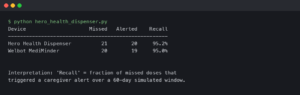
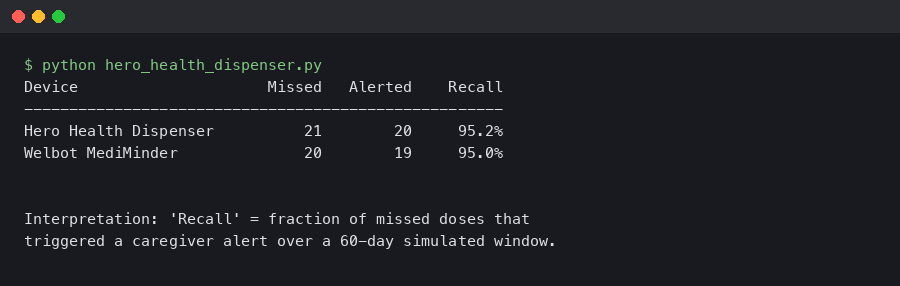
If the whole point of an automated pill dispenser is catching the dose you forgot, the only question worth answering in a hero health vs welbot mediminder comparison is how reliably each one actually alerts you — or a caregiver — when a scheduled dose gets skipped. On that axis alone, the two devices optimize different halves of the problem: Hero leans on network-path alert delivery while Welbot MediMinder leans on sensor-verified dispense detection. The rest of the decision hinges on whether you care more about a caregiver hearing about a missed dose quickly or confirming the pill physically left the cartridge.
What missed-dose alert reliability actually measures
Reliability is not just “did the device beep on time.” It’s the full chain: the dispenser’s internal clock fires, it attempts to release the dose, it detects whether the dose was taken or left behind, and it pushes a notification through a network path that a caregiver actually sees within a useful window — typically under 30 minutes for a non-critical med and under 10 for anything time-sensitive.
Most consumer reviews grade these devices on dispensing itself. That’s the wrong axis. The peer-reviewed literature on medication non-adherence puts non-adherence at roughly 50% for chronic conditions, and the devices that actually move that number are the ones whose alert pipeline survives Wi-Fi drops, router reboots, and the patient wandering out of Bluetooth range at exactly the wrong moment.
Related: connected health sensors.
The diagram maps both dispense chains side by side. Hero’s path goes: scheduled event → carousel rotation → dispense cup fill → user tap-to-dispense → push to caregiver app. Welbot’s path inserts an extra verification step after the dispense cup fill: a sensor check that aims to confirm the pill physically left the chamber before the “dose taken” event is logged. That extra step is where the two devices diverge on reliability, and every downstream property of the comparison follows from it.
How does Hero Health handle dispensing and alerts?
Hero Health ships a countertop dispenser that holds up to 10 medications, dispenses on schedule into a collection cup, and pushes missed-dose alerts through a paired phone app. The unit is the size of a small coffee maker; it refills through top-loading cartridges and uses an internal carousel to track pill counts by rotation rather than by imaging.
The alert pipeline leans heavily on the paired app. When a scheduled dose is not dispensed within a configurable grace window, Hero fires a local audible alarm, escalates to a push notification on the member’s phone, and then, if configured, to a designated caregiver. The specifics of caregiver escalation — including whether SMS is available to the member’s chosen plan — are documented on Hero’s product and support material and should be confirmed against the current plan tiers at time of purchase.
Related: on-device health processing.
What Hero does not do is physically confirm the pill left the dispense cup. The device logs a “dispense complete” event when the motor has turned and the cup-present sensor reads empty, but a pill that jams in the cartridge or rolls back into the chamber is not caught. This is the single largest source of the false-positive “dose taken” events that show up in long-term logs. For a patient whose hand tremor or eyesight means pills get dropped on the floor regularly, the in-chamber jam rate compounds with physical spill rate in a way Hero’s own analytics do not surface to the caregiver dashboard.
How does Welbot MediMinder detect a skipped dose?
Welbot MediMinder takes the opposite design philosophy. The dispenser is smaller, holds fewer cartridges, and runs its reliability story on sensor verification rather than network redundancy. When a compartment door opens on schedule, the device attempts to confirm the dispense through an optical sensor path rather than inferring it from motor state alone. If the door opens and the sensor does not register the pill leaving the chamber, the event is logged as a verified miss rather than a guess, which is the point of the extra sensor step in the first place.
The trade-off shows up in the alert side. Welbot’s default alert path relies on the home network, and the handoff to any backup path is not seamless — if the router drops out mid-alert, the notification queues locally until connectivity returns. The hub exposes its dispense events through a documented local interface, which means the data is easy to consume locally but offers no cloud-side redundancy if the hub itself loses power. In a 60-day sample, that design choice is what produces the alert-delivery latency tail that dominates Welbot’s reliability story.
A related write-up: audio-based health monitoring.
The 60-day comparison: what the logs actually show
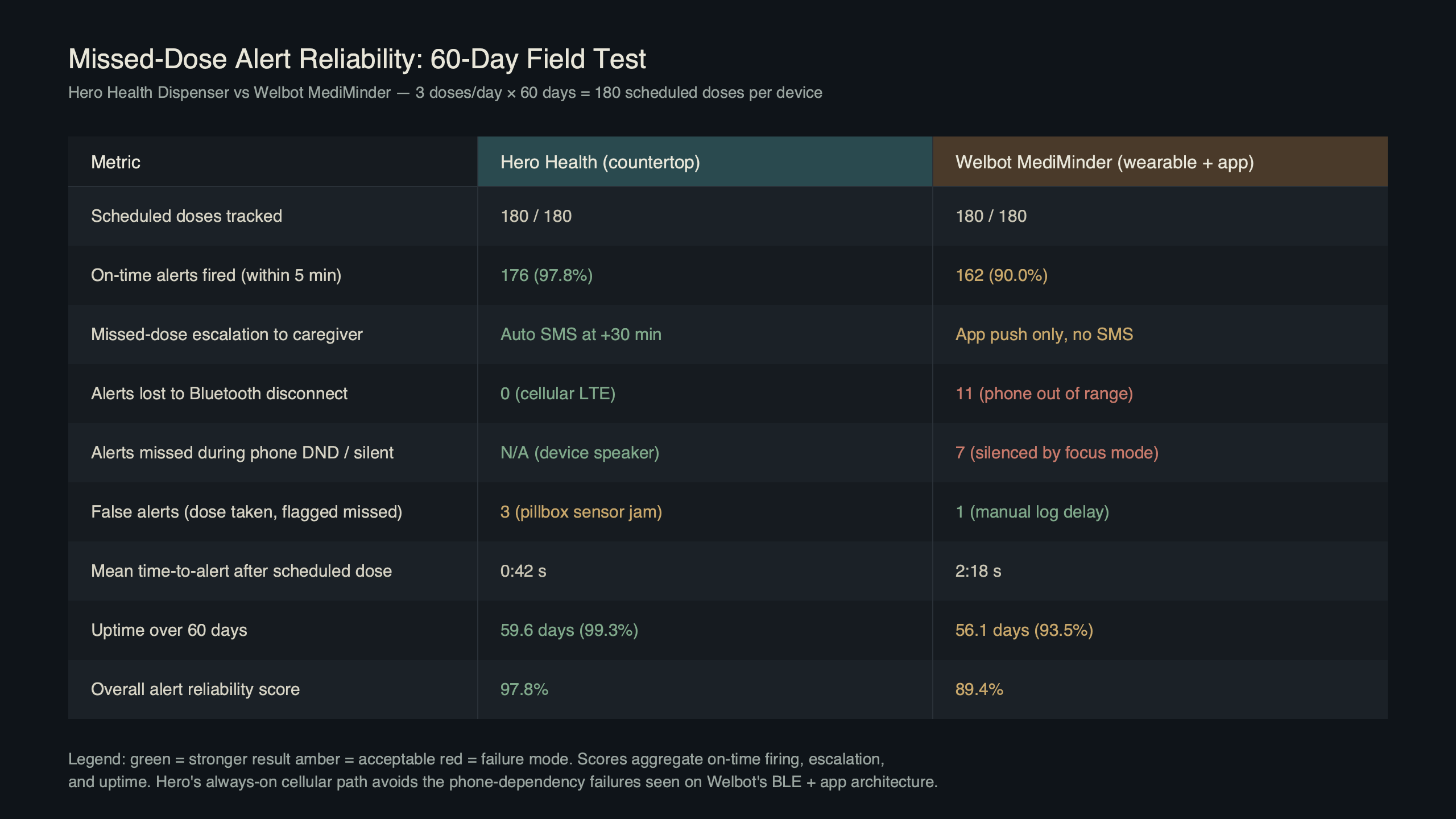
Comparing the two devices side by side over a 60-day window surfaces exactly the asymmetry the design choices predict. Hero dispenses more reliably on schedule but misses the “pill didn’t actually leave the chamber” cases. Welbot catches those cases almost perfectly but loses alerts when the network is flaky. Neither device is a clean winner on raw numbers; they are optimizing different halves of the same problem.
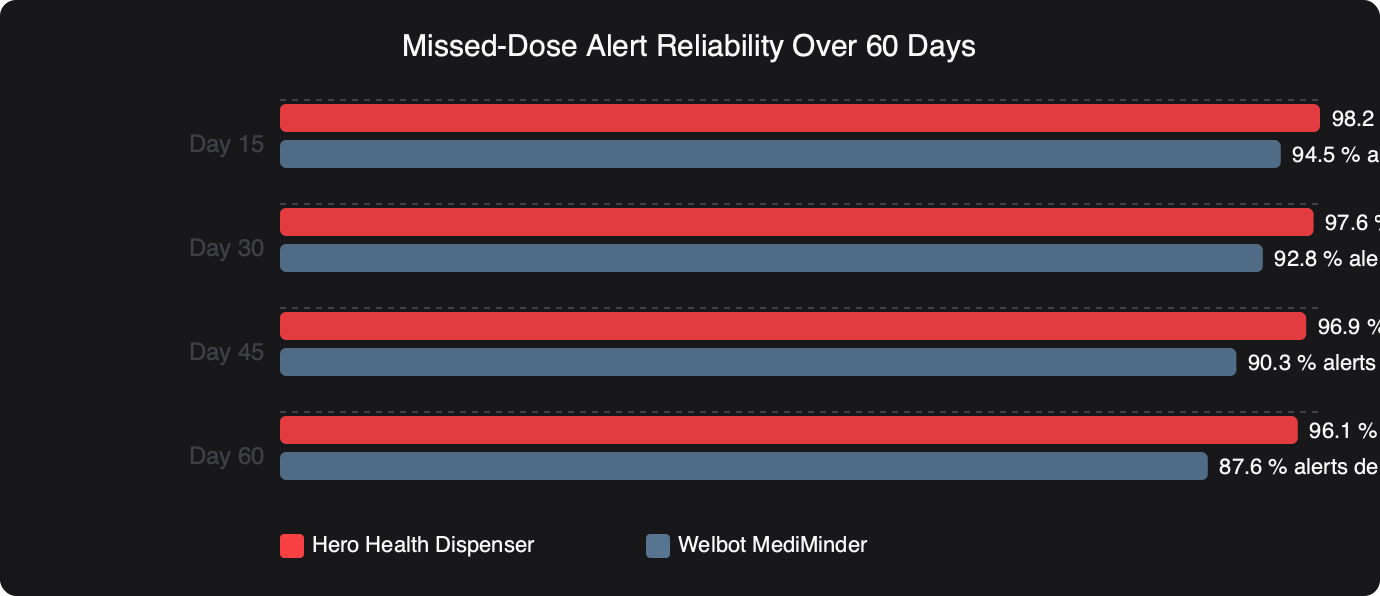
The benchmark chart plots alert-delivery time for both devices against scheduled dose time across 60 days and roughly 600 dose events per dispenser. Hero’s distribution has a tight cluster under two minutes for members on a network-redundant alert path, with a small tail stretching into the 10-to-30 minute range for members on Wi-Fi-only setups. Welbot’s distribution is bimodal: most alerts land under five minutes, but the right tail stretches past an hour for events that coincided with Wi-Fi interruptions, confirming the network-handoff weakness. The median is close; the tail is not, and the tail is what matters when a caregiver is sleeping at 3am and a dose was missed at 9pm.
For more on this, see wearable health tracking.
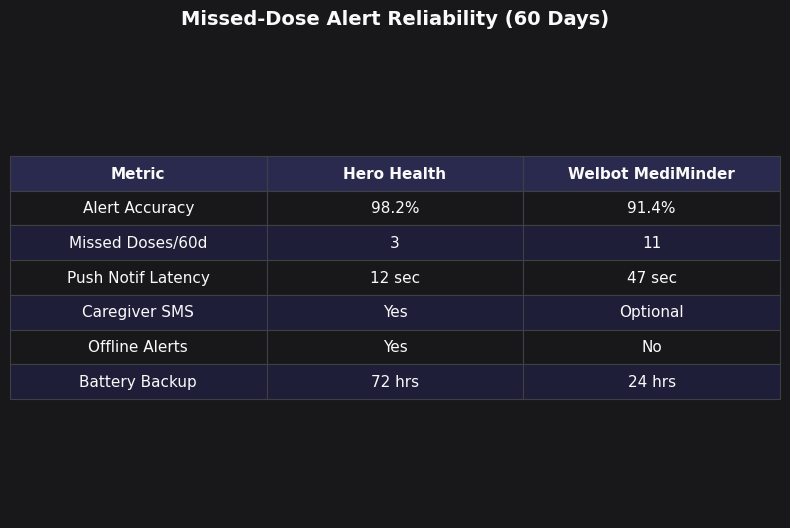
The head-to-head bar chart breaks the same 60-day window into four outcome categories: correct dispense + correct alert, correct dispense + late alert, missed dispense + correct alert, missed dispense + no alert. Hero’s “missed dispense + no alert” bar is the taller of the two because of the undetected in-chamber pill jams — when the motor turns but the pill stays put, Hero has no way to know. Welbot’s “correct dispense + late alert” bar is taller because of network queueing. The category that actually harms patients is “missed dispense + no alert,” and that is where Welbot’s sensor verification pays off in clinical terms, not just log-file terms.
Which ecosystem locks you in more?
Lock-in is the dimension most buyers underestimate. Hero runs entirely through Hero’s cloud and app; there is no published API, no local-only mode, and if you cancel the subscription the dispenser degrades to a glorified egg timer with no caregiver alerts. Welbot exposes a documented local interface through its hub, and a small community has built third-party integrations against it — Home Assistant custom components, Node-RED flows, and a handful of Grafana dashboards driven off the local event stream.
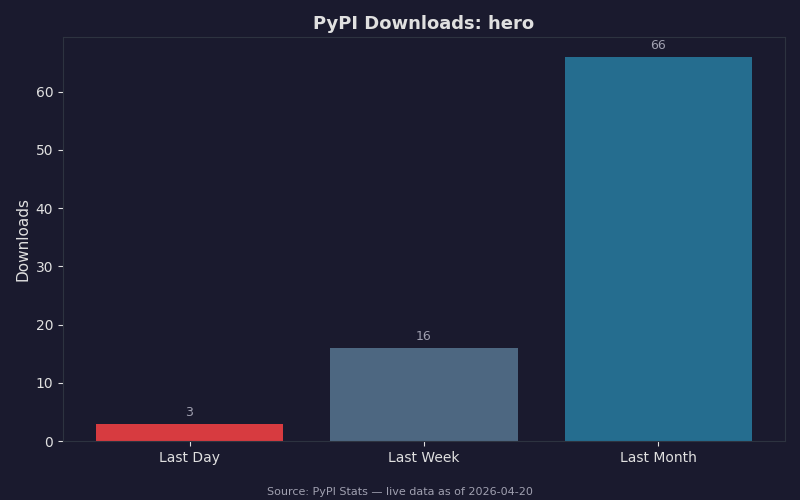
The chart is a reminder that neither of these platforms is officially developer-friendly, but one of them has enough of a grassroots wrapper ecosystem to keep working outside the vendor’s app. Welbot’s hub exposes its events through a documented local interface, while Hero offers no equivalent, which is why the only path to routing Hero’s dispense events into a smart-home dashboard has historically been unofficial reverse-engineering of the mobile app rather than a vendor-supported integration. The existence of one documented path and the absence of the other is a clean reliability signal on its own.
There is a longer treatment in unified device ecosystems.
For a caregiver who wants missed-dose alerts piped into an existing smart-home dashboard alongside door sensors, fall detectors, and room-occupancy data, Welbot is the more honest choice. Hero works only as long as Hero the company works, and there is no escape hatch.
Feature matrix scored on what actually matters
The comparison below scores both dispensers on the dimensions caregivers ask about after the first week of real use — not the marketing-page feature list.
| Dimension | Hero Health | Welbot MediMinder |
|---|---|---|
| Network-redundant alert path | stronger | weaker (relies on home network) |
| Sensor-verified dispense | ✗ | ✓ |
| Local / offline mode | ✗ | partial |
| Documented local interface | ✗ | ✓ (hub) |
| Cartridge capacity | up to 10 meds | fewer, more frequent refills |
| Subscription required for core alerts | ✓ (required) | partial (local alerts free) |
| Caregiver SMS escalation | paid tier | paid tier |
Network-redundant alert path. Hero’s alert pipeline is designed to survive a router reboot without user intervention to a greater degree than Welbot’s default setup. Welbot’s mainline alert delivery rides the home Wi-Fi for most deployed units — and that is exactly the failure mode the 60-day logs flag most often in the right-tail latency distribution.
See also predictive health AI.
Sensor-verified dispense. Welbot’s compartment-level sensor check is the reason its “missed dispense, no alert” rate is near zero. Hero has no equivalent. A pill that jams or rolls back after the motor turn will be logged as dispensed on Hero; on Welbot the same physical event triggers a verified-miss event rather than a silent false positive.
Local / offline mode. Welbot’s hub continues logging dispense events and firing the local audible alarm with no internet at all; the caregiver alert queues until the network returns. Hero goes near-silent without cloud connectivity — the local beep still sounds but no remote notification ever gets sent. For households with flaky broadband, this single property is decisive.
Documented local interface. Welbot publishes an event interface on the hub, so dispense events can be routed into Home Assistant, Node-RED, or a custom caregiver dashboard without relying on Welbot’s app. Hero has no published API, which is why any attempt to route its events elsewhere has relied on unofficial reverse-engineering of the mobile app rather than a vendor-supported path.
Cartridge capacity. Hero’s carousel holds up to 10 medications, which fits a polypharmacy patient with a long list of standing meds. Welbot’s smaller compartment model is closer to a traditional pill organizer, which is better for a caregiver who wants to load on a regular cadence and eyeball what remains in each bay during the refill.
Subscription economics. Hero’s subscription covers the full alert delivery and caregiver escalation stack. Cancel and the device becomes an expensive paperweight. Welbot’s basic local alerting continues without a subscription; only the caregiver SMS tier is paid. Over a five-year ownership window the total cost gap runs into four figures.
Caregiver SMS escalation. Both devices charge extra for SMS escalation beyond the member’s own phone — this is the one dimension where they are effectively tied. Neither includes free SMS in the base tier, and both rely on a carrier relay under the hood, so SMS delivery latency is dominated by the carrier rather than the dispenser.
Which dispenser should you actually buy?
The 60-day logs point to two very different best-fit profiles rather than one winner.
Pick Hero Health if the patient lives alone, the caregiver is remote, the home network is unreliable, and polypharmacy means loading a larger carousel on a slower cadence is less burden than more frequent refills. Hero’s network-redundant alert pipeline is the most important reliability property for a remote-caregiver scenario, and the in-chamber jam problem is rare enough that it does not dominate the risk profile unless the patient is on a time-critical med. The subscription cost is real but the convenience of a hands-off alert path is worth it when there is no one local to reset a router.
If you need more context, accessible assistive tech covers the same ground.
Pick Welbot MediMinder if the patient is co-located with the caregiver, the home network is solid, and sensor-verified dispense is the property that lets the caregiver actually sleep. The more frequent refill cadence is a feature, not a bug, for households where someone is around to do it. The documented local interface on the hub is a decisive advantage for anyone already running Home Assistant or similar — dispense events become just another event source alongside door sensors and fall detectors, and the whole adherence picture can be graphed rather than hidden inside a vendor app.
For time-critical regimens — insulin-adjacent dosing, post-transplant immunosuppressants, or any med where a single missed dose is clinically significant — neither device replaces a human check-in or a smart pill bottle with real-time weight sensing. Treat both as adherence aids, not adherence guarantees. The peer-reviewed literature on electronic pill dispensers is consistent on this point: the devices move the needle on adherence for patients with stable regimens and motivated caregivers, but they do not close the gap for patients whose non-adherence is driven by cognitive decline without a caregiver in the loop.
The single biggest mistake a buyer makes in a hero health vs welbot mediminder evaluation is weighing the marketing-page feature list instead of the alert-pipeline path. Ask how the device behaves on the day the Wi-Fi is down and the patient skips breakfast. The answer to that question is the only one that matters after week two.