


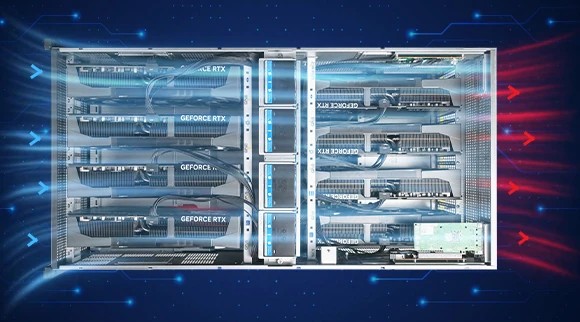
So there I was last Tuesday, standing in an empty parking lot outside Atlanta, watching a $4,000 custom quadcopter slowly descend because the Jetson Orin Nano strapped to its belly hit 92°C and throttled itself into oblivion. The marketing brochures for these new aerial crowd monitoring systems conveniently leave out the thermal realities of running continuous pose-estimation at 400 feet while fighting a 15-knot crosswind.
We are seeing a massive push right now for Drone as First Responder (DFR) programs and automated stadium security. The idea is highly appealing. A drone spots a violent crowd anomaly or a weapon before a human operator does, using onboard temporal reasoning. But making it work on edge hardware without melting the chassis is a completely different story.
The YOLO-Drone Reality Check
I spent the last three months testing various UAV-tailored object detectors. The academic papers from late 2025 made it sound like the problem was solved. They promised massive mean Average Precision (mAP) gains on the VisDrone datasets just by tweaking the feature pyramid and using Soft-NMS.
I flashed a custom YOLOv8n-pose model onto my rig running Ubuntu 24.04 LTS. On my desktop workstation? Beautiful. It chewed through 4K video at 120 fps. But when I actually put it in the air, the reality of edge compute hit hard.
Here is the specific gotcha nobody mentions about temporal reasoning models on a UAV: gimbal roll. Models that use temporal reasoning to detect actions (like fighting or running) rely heavily on frame-to-frame pixel consistency. When your drone banks sharply to fight a sudden gust of wind, the entire background shifts 30 degrees instantly. The temporal tracking completely shatters. You end up with forty phantom bounding boxes flagging “anomalous behavior” because the algorithm thinks the crowd just leaped sideways at 40 miles per hour.
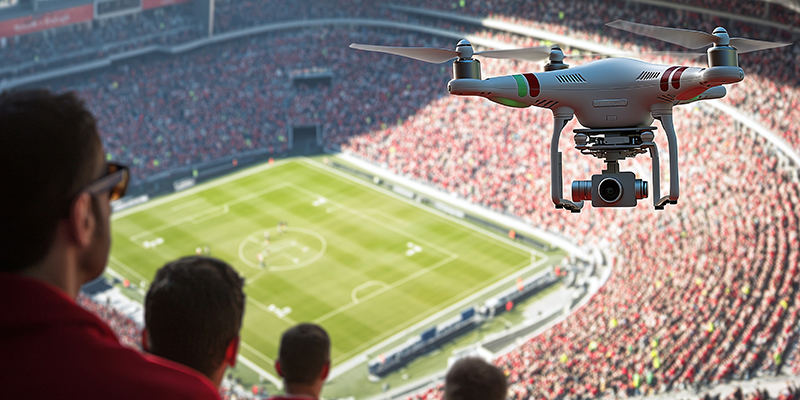
You have to heavily filter the confidence thresholds, which then makes the system miss actual anomalies. It is a frustrating balancing act.
Software Fixes and Hardware Limits
I will admit that some of the newer edge enhancements actually do what they claim. I recently implemented an EDNet-style pipeline for small-target detection, and it legitimately dropped my memory usage from 3.8GB down to 1.2GB. That lower memory overhead kept the compute board cooler and bought me an extra four minutes of flight time. A win is a win.
But the processing demands of combining AI with thermal or LIDAR payloads—like what AEYE Detect does—are pushing battery-powered drones to their absolute limits. You cannot run a high-res optical feed, a thermal feed, and an onboard neural network on a battery that also has to keep four rotors spinning for 30 minutes. The math just does not work.
This is exactly why the most successful commercial deployments at places like SoFi Stadium rely heavily on tethered drones. Companies like Hoverfly figured this out a while ago. You run a physical power and data line up to the drone. It stays in the air for 12 hours, and you offload all that heavy AI compute to a server rack sitting safely in an air-conditioned security room on the ground. It is decidedly less glamorous than a fully autonomous swarm, but it actually works.
The Interference Irony
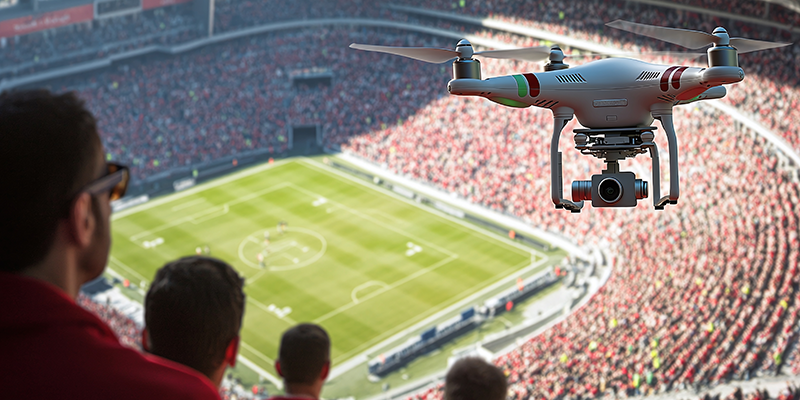
There is also a bizarre operational irony happening at large public events right now. Venue security teams are deploying these AI-equipped drones to monitor the perimeter and integrate with ground-based weapons screening systems like Evolv.
At the exact same time, they are running aggressive counter-UAS protection to keep unauthorized drones out. I was at an event last month where they had an Echodyne radar system co-deployed with their own surveillance swarm. The RF environment was an absolute mess. The security team spent half the morning whitelisting their own MAC addresses and trying to stop the Dedrone system from jamming their own overwatch feeds.
When you have dozens of automated systems screaming at each other over the same frequency bands, your latency spikes. And when your temporal reasoning AI relies on a steady 30 fps stream to detect a threat, a 500-millisecond network stutter renders the entire system useless.