





Introduction: The Dawn of the Intelligent Lens
The landscape of consumer technology is undergoing a seismic shift, moving away from the rectangular screens held in our palms toward a more immersive, heads-up future. For years, AR/VR AI Gadgets News has been dominated by bulky headsets designed for gaming or niche enterprise applications. However, a new trend is emerging that promises to integrate digital information seamlessly into our physical reality: the fusion of lightweight Assisted Reality (aR) glasses with powerful Generative AI. We are witnessing the transition from “smart” devices that simply display notifications to “intelligent” wearables that understand context, process natural language, and offer proactive assistance.
This evolution is driven by the rapid maturation of Large Language Models (LLMs) and significant breakthroughs in optical waveguide technology. No longer burdened by heavy batteries and socially awkward designs, the next generation of eyewear aims to be indistinguishable from standard prescription frames. As Smart Glasses News cycles accelerate, the focus is shifting toward devices that act as an extension of the smartphone—a multimodal interface where voice, vision, and AI converge. This article explores the technical underpinnings, real-world applications, and future implications of this technological symbiosis, marking a pivotal moment in the history of personal computing.
Section 1: Hardware Evolution – From Heavy Headsets to Invisible Tech
To understand the significance of the latest prototypes and market releases, one must appreciate the hardware engineering challenges that have plagued the AR industry for a decade. The “Holy Grail” has always been a device weighing under 50 grams that offers all-day battery life and a display bright enough to compete with sunlight. We are finally approaching this reality.
The Optical Breakthrough: Resin Waveguides
Traditional AR solutions often utilized “birdbath” optics, which, while providing good field of view (FOV), resulted in thick, bug-eyed designs. The current wave of innovation, highlighted in recent Wearables News, focuses on diffractive waveguide technology. Specifically, the industry is moving toward high-refractive-index resin waveguides. Unlike glass, resin is lighter and more shatter-resistant, allowing manufacturers to craft lenses that look and feel like standard eyewear.
When paired with Micro-LED projectors—some no larger than a grain of rice—these waveguides can deliver monochrome or full-color visuals directly to the user’s retina without obstructing their view of the world. This is a massive leap forward for AI in Fashion / Wearable Tech News, as tech companies finally acknowledge that aesthetics are just as critical as functionality.
The Tethering Strategy
A critical engineering decision in modern lightweight AR glasses is the “split-computing” architecture. Rather than cramming a high-heat processor and heavy battery into the temple of the glasses, manufacturers are utilizing the immense processing power of modern smartphones. This synergy is a frequent topic in AI Phone & Mobile Devices News. By using the phone as the compute engine and the glasses as the display and sensor array, devices can remain slim. The connection—often via low-latency Bluetooth or proprietary wireless protocols—allows the glasses to leverage the phone’s 5G connection and neural processing units (NPUs) to run complex AI models.
Sensors and Multimodal Input
The hardware isn’t just about output; it’s about input. The latest smart glasses are equipped with reverse sound field technology to prevent audio leakage, ensuring privacy during calls. Furthermore, the integration of microphones optimized for voice isolation is crucial. While AI Sensors & IoT News often focuses on industrial applications, in smart glasses, these sensors are the bridge between the user’s intent and the AI’s execution. Capacitive touch bars on the temples allow for subtle swiping gestures, creating a hybrid interaction model of voice, touch, and head tracking.
Section 2: The Brains of the Operation – Generative AI Integration
Hardware is merely the vessel; the true revolution lies in the software. The integration of LLMs into wearable form factors is transforming smart glasses from passive displays into active, conversational agents. This is the most exciting development in AI Assistants News.
Beyond “Hey, Computer”
Legacy voice assistants were command-based, requiring rigid syntax to set timers or play music. The new generation of AR glasses integrates Generative AI, allowing for natural, fluid conversation. Users can ask complex, multi-part questions, request summaries of incoming messages, or ask for creative writing assistance while walking down the street. This mirrors trends seen in AI Audio / Speakers News, but with the added dimension of visual feedback. The AI doesn’t just read the answer; it displays bullet points, images, or navigation arrows directly in the user’s line of sight.
Multimodal AI: Seeing What You See
The convergence of AI-enabled Cameras & Vision News with smart eyewear is perhaps the most transformative feature. When equipped with cameras, these devices can analyze the user’s environment. An AI agent can identify a flower in a garden (relevant to AI Gardening / Farming Gadgets News), translate a restaurant menu in real-time, or guide a mechanic through an engine repair by highlighting specific parts. This capability moves the device from a notification center to a context-aware tool that augments human intelligence.
The Ecosystem of “AI Agents”
We are moving toward an ecosystem where your glasses communicate with other smart devices. Imagine walking into your living room; your glasses recognize you are home and communicate with the thermostat and lights. This intersects with Smart Home AI News and AI Lighting Gadgets News. The glasses become the central command node for the IoT ecosystem, bypassing the need to pull out a phone or shout at a stationary smart speaker. The AI agent in the glasses acts as the orchestrator, managing data flows from Robotics Vacuum News updates to security alerts from AI Security Gadgets News.
Section 3: Real-World Applications and Case Studies
The theoretical capabilities of AI-infused AR glasses are impressive, but their value is proven in practical application. Here is how this technology is reshaping various sectors.
The Modern Office and Remote Work
In the realm of AI Office Devices News, smart glasses are emerging as the ultimate productivity tool. Consider a public speaker or an executive giving a presentation. With AR glasses, they have a teleprompter that only they can see. During meetings, the AI can provide real-time transcription and summarize key action items floating in the user’s peripheral vision. This is also a boon for AI Tools for Creators News, allowing content creators to see live stream chats or camera settings without breaking eye contact with their audience.
Accessibility and Inclusion
One of the most profound impacts is found in AI for Accessibility Devices News. For the hearing impaired, AR glasses can provide real-time closed captioning of conversations happening in the real world. For the visually impaired, the AI vision capabilities can describe the environment, read street signs, or identify obstacles, effectively acting as a digital guide dog. This democratization of information is a key driver for the adoption of the technology.
Health and Wellness
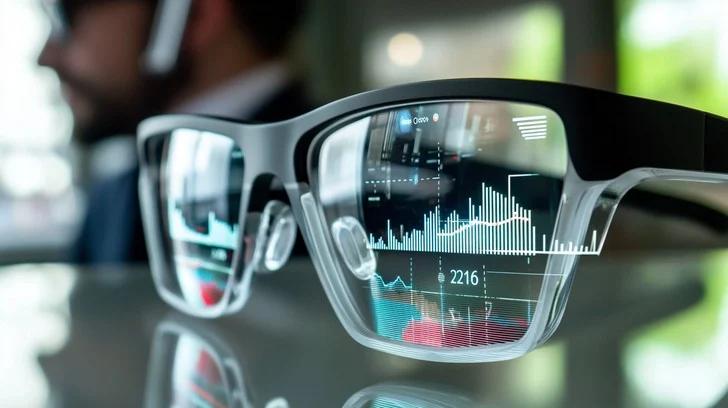
While AI Fitness Devices News usually revolves around smartwatches, AR glasses offer a heads-up display for runners and cyclists, showing pace, heart rate, and navigation without the need to look down at a wrist. Furthermore, in the context of AI Sleep / Wellness Gadgets News, these devices can monitor fatigue levels by analyzing blink rates and head posture, alerting drivers or workers when they are becoming too tired to operate safely.
Travel and Navigation
For the global traveler, the language barrier is effectively dissolved. AI for Travel Gadgets News highlights how these devices can listen to a foreign language and project the translation as subtitles in real-time. Navigation becomes intuitive; instead of looking at a 2D map on a phone, the user sees directional arrows overlaid on the actual street, guiding them to their destination with precision.
Section 4: Challenges, Privacy, and the Road Ahead
Despite the hype, significant hurdles remain before mass adoption occurs. A balanced view of AR/VR AI Gadgets News requires a look at the limitations and risks.
The Privacy Paradox
The inclusion of cameras and microphones in eyewear raises substantial privacy concerns. Just as AI Research / Prototypes News pushes the boundaries of capability, society must grapple with the ethics of always-on recording. Manufacturers are implementing LED indicators that flash when recording, but the potential for misuse remains. This is a critical topic in AI Security Gadgets News, as the data collected by these devices—voice prints, visual data, location history—is incredibly sensitive.
Battery Life and Thermal Management

Physics remains a harsh mistress. Powering a display, a wireless connection, and onboard sensors generates heat. In a device worn on the face, thermal management is non-negotiable. While AI for Energy / Utilities Gadgets News focuses on macro grids, micro-energy efficiency is the battleground for wearables. Current prototypes often sacrifice brightness or processing power to maintain a comfortable temperature and decent battery life, often lasting only a few hours of continuous active use.
Latency and Edge Computing
For an AI assistant to feel natural, the response time must be near-instantaneous. Relying on cloud processing introduces latency. The solution lies in AI Edge Devices News—moving the processing to the local device (the phone or the glasses themselves). However, running heavy LLMs locally requires significant NPU power and drains batteries faster. The industry is currently balancing between “tiny” local models for quick tasks and cloud-based “giant” models for complex queries.
Market Fragmentation
The sector is currently fragmented. We see developments in AI Personal Robots News, Drones & AI News, and AI Toys & Entertainment Gadgets News all vying for consumer attention. Smart glasses must prove they are not just another gadget to charge, but a replacement for existing friction points. They need to offer utility that surpasses the smartphone, not just replicates it.
Conclusion: The Invisible Interface
The convergence of Augmented Reality and Generative AI represents a fundamental change in human-computer interaction. We are moving away from the era of “heads down” computing, where our attention is constantly hijacked by screens, to an era of “heads up” computing, where technology enhances our interaction with the physical world. While AI in Gaming Gadgets News will always drive high-end VR hardware, the subtle, lightweight AR glasses discussed here will likely have a broader impact on daily life.
From AI Education Gadgets News transforming how students learn, to Smart City / Infrastructure AI Gadgets News allowing engineers to visualize utilities under the street, the applications are limitless. As prototypes evolve into consumer products, the winning devices will be those that balance style, comfort, and the sheer utility of having a genius-level AI assistant whispering in your ear and guiding your eyes. The future of gadgets isn’t just about being smart; it’s about being insightful, invisible, and indispensable.