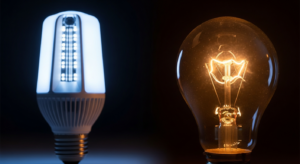

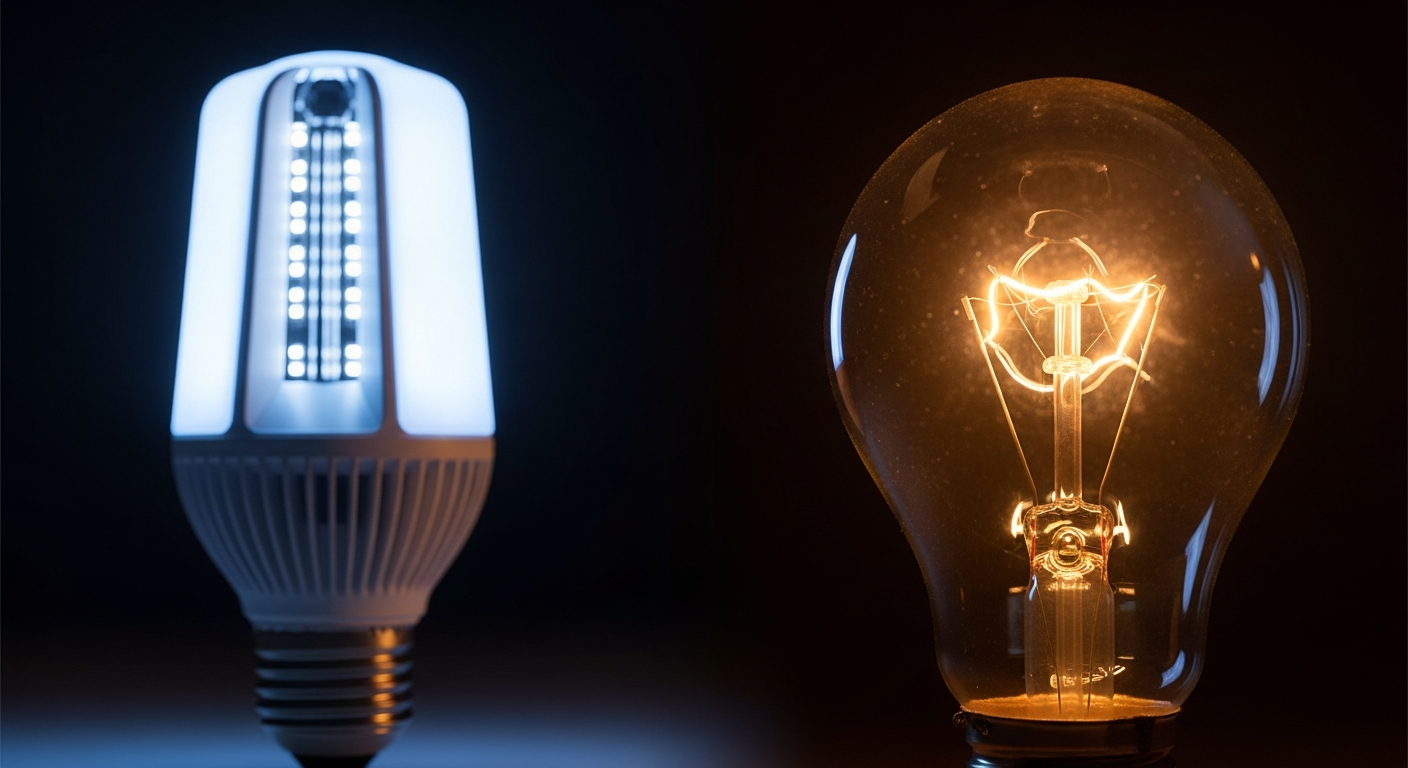
For almost every household in 2026, a dumb LED bulb sitting under a Matter-over-Thread smart switch beats any bulb sold as “AI” or “smart.” The bulb itself contributes no real intelligence — every behavior people pay for (schedules, scenes, sunrise fades, voice, color, occupancy) is performed by the layer above it. Put control logic in the bulb and you inherit the entire failure surface of that layer, while losing the one thing dumb LEDs are exceptional at: lasting many years with zero firmware to break.
In this post: What “AI” in a lightbulb actually means in 2026 · Where the intelligence in your lighting actually lives · The wall-switch problem that disqualifies bulb-side intelligence · The firmware-life vs LED-life mismatch and the vendor-shutdown graveyard · Standby power, security surface, and the costs of always-online bulbs · The decision rubric: who actually should buy a smart bulb · The strongest counter-argument · What to buy in 2026 instead · References
- A modern LED bulb’s rated life vastly outlasts the typical connected-bulb vendor’s cloud, which has historically been supported for only three to seven years.
- Insteon’s cloud servers went dark in April 2022, breaking thousands of bulb-driven setups — the same pattern that hit Lowe’s Iris (2019).
- A smart bulb fed by a dumb wall switch becomes a brick the moment a guest flips the switch off — the single most common failure mode of bulb-side intelligence.
- Matter 1.4 over Thread lets a dumb bulb participate in a local, multi-admin, future-proof lighting stack via a smart switch — no vendor cloud in the loop.
What “AI” in a lightbulb actually means in 2026
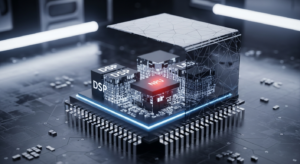
Walk the shelves at any big-box electronics retailer this spring and you will find boxes promising “AI lighting,” “intelligent ambience,” and “adaptive scenes.” Strip the marketing off and the claims fall into three buckets: cloud-side scheduling (a server triggers your bulb at sunset), on-device sensing (a photoresistor or a coarse ambient-light reading), and genuine onboard inference. The third bucket is empty. There is no neural network running inside a 15-watt screw-base device. The MCU has perhaps a few hundred kilobytes of flash, a Wi-Fi or Thread radio, and a PWM driver. Calling that “AI” is a category error.
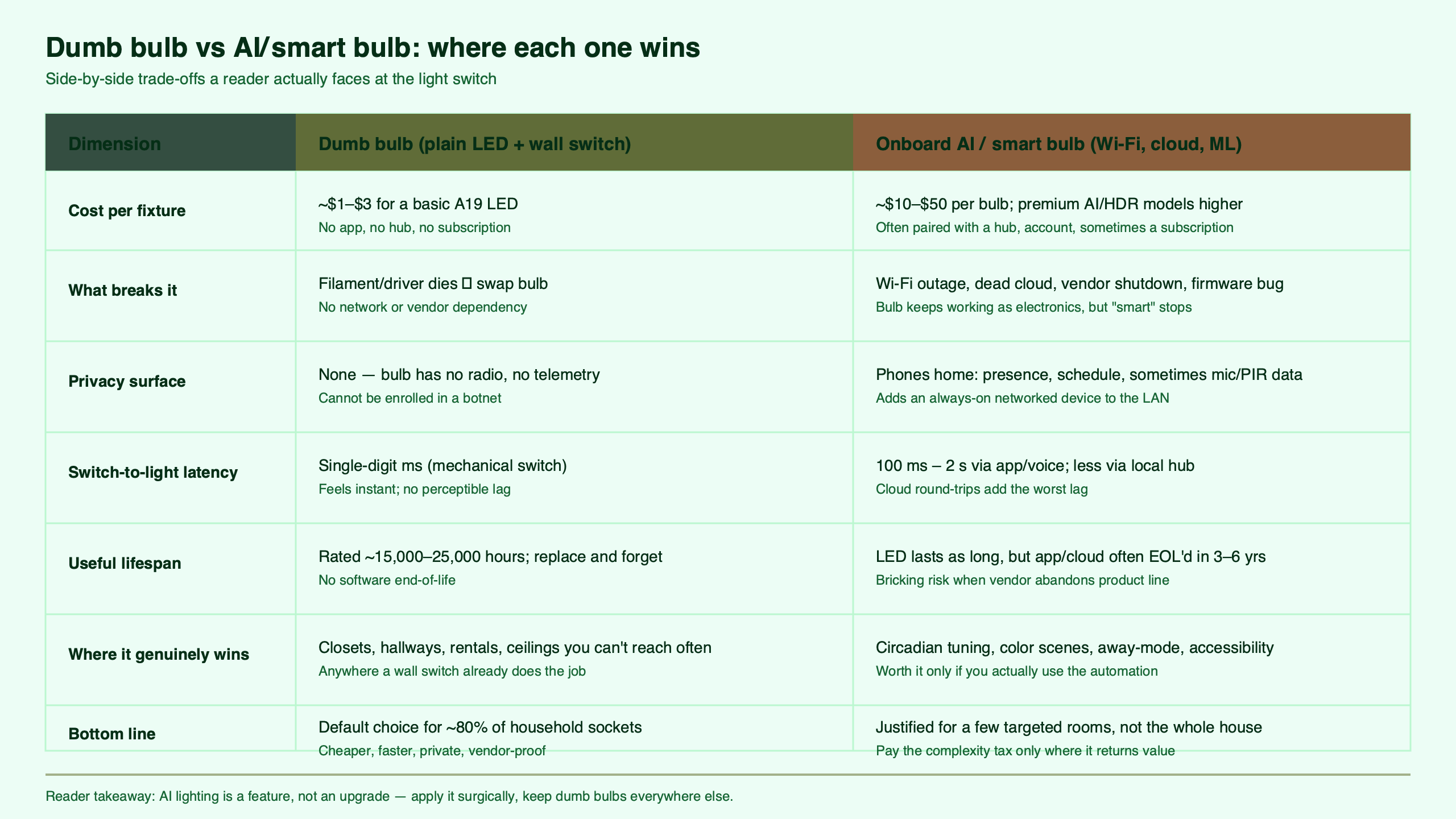
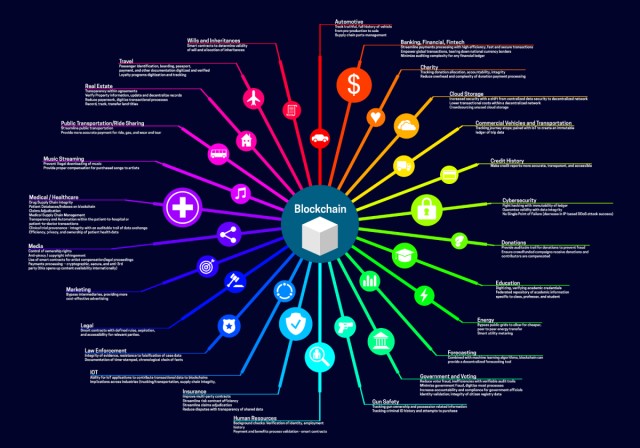
Purpose-built diagram for this article — In defense of dumb bulbs over onboard AI lighting.
If you need more context, the broader AI-plus-light convergence pitch covers the same ground.
The diagram above maps the marketing claim to the actual layer doing the work. Notice that every behavior — sunrise simulation, voice control, scenes, even “adaptive” color temperature — terminates at a server or an app, not at the bulb. The bulb is the dumbest node in the system regardless of what the box says.
Where the intelligence in your lighting actually lives
Lighting “intelligence” in 2026 is a stack of four layers, and the bulb sits at the bottom. The automation engine (Home Assistant, HomeKit, SmartThings, Google Home) holds the rules. The hub or controller (a HomePod mini, a Nest Hub, a Pi running Home Assistant) executes them locally. The protocol layer (Matter, Thread, Zigbee, Z-Wave) carries the on/off, dim, and color commands. The bulb merely renders the result by varying current to its LED string.
| Behavior | Bulb | Hub / Controller | Automation engine | Vendor cloud |
|---|---|---|---|---|
| Schedules | — | Yes | Yes | Sometimes |
| Sunrise / sunset fade | — | Yes | Yes | Sometimes |
| Voice command | — | Routing | — | Yes (Alexa / Google) |
| Scenes (multi-bulb) | — | Yes | Yes | — |
| Color / CCT change | Renders | Commands | — | — |
| Occupancy response | — | Sensor + rule | Yes | — |
| Local power on/off | Yes | — | — | — |
The only column where the bulb contributes is “render the final state.” That work is identical for a dumb LED if a Matter-over-Thread switch upstream cuts or modulates power. Putting intelligence in the bulb buys nothing the rest of the stack does not already do better.
More detail in where generative AI actually sits in the smart home.
The wall-switch problem that disqualifies bulb-side intelligence
This is the single argument that should end the conversation. A smart bulb requires constant mains power; the moment anyone flips the wall switch off, the bulb stops responding. Your automation graph orphans the node. Schedules misfire. The voice assistant says “device unreachable.” Guests, cleaners, kids, and your past self do this constantly. The category fix sold by every vendor — “just leave the switch on forever” — is a workaround, not a solution. It also fails the moment someone toggles the switch out of habit.
A dumb bulb sitting under a smart switch has the opposite failure mode: the switch is what holds state. The bulb is always reachable as long as the switch is energised, because the switch decides when and how to energise it. The user-facing affordance (a physical paddle on the wall) and the automation-facing affordance (an addressable device on the network) finally agree.
There is a longer treatment in what on-device inference silicon can realistically do.
The firmware-life vs LED-life mismatch and the vendor-shutdown graveyard
A modern LED bulb is engineered to last many years of normal household use — the physical asset you are buying. Now consider the support window for the firmware and cloud sitting on top of it. Lowe’s shut down Iris in 2019. Insteon — a company whose protocol genuinely lived in the device, not just the cloud — went silent in April 2022 when its cloud services stopped, and only survived because users pooled funds to buy the corpse. Wink throttled non-paying users into uselessness. Belkin’s WeMo cloud has been contracting for years.
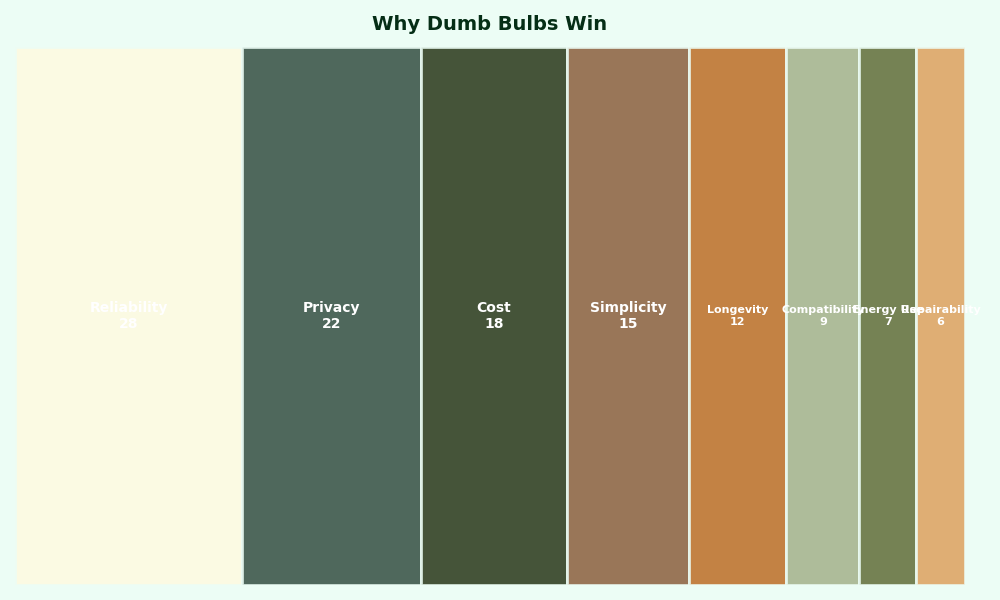
Category breakdown — Why Dumb Bulbs Win.
A related write-up: a firmware update that broke a shipped device.
The table above stacks the LED life expectancy against the typical cloud lifespan. The pattern is mechanical: the bulb outlives the company. When the company goes, the “smart” half of the bulb goes with it, and you are left holding either a dumb bulb you paid premium for, or — worse, with most Wi-Fi-only models — a paperweight that will not even respond to the cheap dumb dimmer you wanted to replace it with.
Standby power, security surface, and the costs of always-online bulbs
Then there is the security surface. Every Wi-Fi bulb is a Linux-class device on your LAN with an upstream cloud tunnel. The 2020 Check Point disclosure showed remote code execution on a Philips Hue bulb via Zigbee — a clean bulb, professionally maintained — and even that ecosystem has had to patch repeatedly. Cheaper Tuya-based bulbs ship with weaker defaults and inconsistent update tracks. The dumb bulb’s attack surface is the filament-equivalent.
The decision rubric: who actually should buy a smart bulb
This is not an absolutist piece. There are narrow cases where the smart bulb is the right answer because the switch alternative does not exist. The rubric below names them honestly.
always-online consumer hardware quietly leaking telemetry goes into the specifics of this.
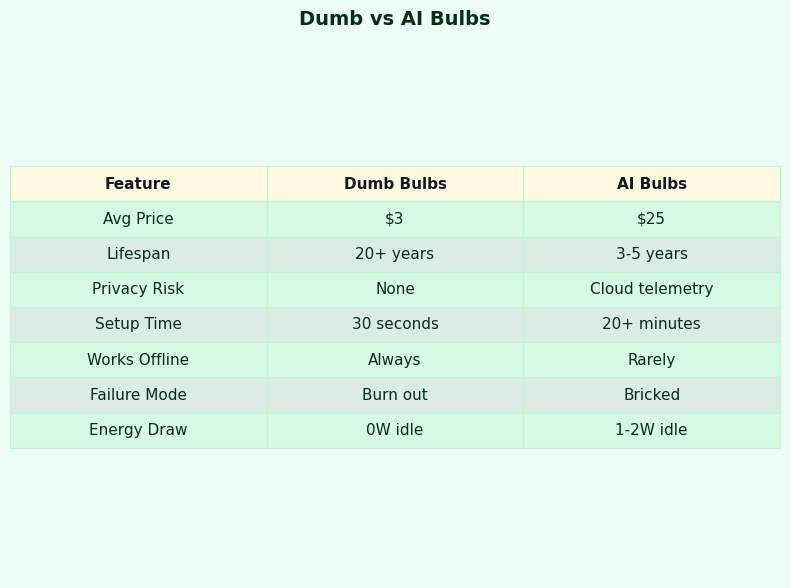
The comparison above makes the choice explicit by household profile. The smart bulb wins in exactly three lanes: rentals where you cannot legally change the switch, single-socket fixtures like a floor lamp on a cord with a pull-chain, and colour-critical setups (photography, mood rooms, accessibility cueing) where you need per-bulb addressable RGB and there is no Matter-controllable downlight option. Everywhere else — owner-occupied homes with neutral wires available, accessibility-first setups that benefit from a tactile paddle, multi-occupant households where any guest will flip switches — the smart-switch-over-dumb-bulb stack is the better call.
| Household profile | Recommended layer | Why |
|---|---|---|
| Owner-occupier, ceiling fixtures | Dumb LED + Matter smart switch | Wall affordance preserved, bulb stays cheap, LED outlives the controller. |
| Renter, cannot replace switches | Smart bulb (Matter preferred) | Switch swap is off-limits; bulb is portable. |
| Floor / table lamps on pull-chains | Smart plug or smart bulb | No wall switch in the loop; either layer works. |
| Multi-occupant household | Dumb LED + smart switch | Guests flip switches; bulb-side logic dies on contact with reality. |
| Accessibility-first (motor / vision) | Dumb LED + smart switch + voice | Tactile paddle remains usable when network or voice fails. |
| Short-term rental host | Dumb LED + smart switch | No guest education needed; switch behaves like a switch. |
| Photography / colour-critical | Addressable smart bulb (Matter) | Per-bulb RGB control is the actual requirement. |
The strongest counter-argument
The fair objection: smart switches need a neutral wire, and a meaningful number of older US homes do not have one in every box. That is real. Pre-1980s construction, especially in single-storey or pre-NEC-1999 wiring, often lacks neutrals at switch locations, and pulling new Romex can cost more than buying every fixture in the house a smart bulb. For those homes, the smart bulb is a legitimate, if compromised, answer — until renovation. Lutron’s Caséta line dodges this entirely with a no-neutral-required design, and several Matter-friendly relays (Shelly, Aqara) also work without neutrals; the rubric for that household becomes “no-neutral smart switch first, smart bulb only where the switch literally cannot fit.” The objection narrows the universe of dumb-bulb-plus-switch homes; it does not refute the architecture.
What to buy in 2026 instead
Pair Energy Star–rated dumb LEDs in the 800–1100 lumen range from any reputable brand with a Matter-over-Thread or Zigbee smart switch (Lutron Caséta, Inovelli Blue, Aqara H1, or a Shelly relay tucked behind the wall plate). Add a Thread border router you already own — an Apple HomePod mini, a Nest Hub 2nd gen, an Eero with Thread radio — and run automations locally in Home Assistant or HomeKit. The bulb is cheap and long-lived. The switch is replaceable in minutes without changing a single fixture. The intelligence sits at the layer that can actually carry it. That is the stack the “AI bulb” page-one results were quietly arguing for the whole time; they just put the smart label on the wrong device.
If you want to keep going, another firmware rollout that stripped advertised features is the next stop.
I wrote about smart-home gear where the compute genuinely belongs if you want to dig deeper.
References
- The Register — Smart home biz Insteon goes silent as cloud services stop (April 2022)
- Bertoldi et al., Energy and Buildings — Evaluating the standby power consumption of smart LED bulbs
- matter-smarthome.de — Matter 1.4.2 update notes (security and convenience improvements)
- Nanoleaf — Matter-over-Thread A19 smart bulb product specification
- Hackaday — Insteon abruptly shuts down, users left smart-home-less